
Academic-Practice partnerships in nursing are getting renewed attention for a reason. Nursing schools and health systems are both trying to solve the same workforce problem from different sides. Schools need enough quality clinical experiences to prepare students well, while health systems need new nurses who can step into practice with stronger readiness, clearer support, and less variation in performance.
AACN and AONL’s Academic-Practice Partnership Playbook: From Shared Vision to Action was created for chief nursing executives, nursing school deans, and other leaders building effective, sustainable collaborations. The playbook describes Academic-Practice partnerships as intentional, formal relationships designed to expand nursing school capacity, improve the practice readiness of new nurses, and build a more sustainable nursing workforce.
For many organizations, that is the real challenge now. The idea of partnership is not new. What matters is whether the partnership is structured well enough to improve nurse readiness, reduce variation, and hold up over time, with shared competency expectations, consistent validation, and clearer visibility into learner progression from education into practice.
Table of Contents
What Is an Academic-Practice Partnership in Nursing?
An Academic-Practice partnership is a formal collaboration between nursing education leaders and nursing practice leaders. AACN describes these partnerships as intentional and formalized relationships based on mutual goals, respect, shared knowledge, and a commitment to excellence.
In practice, a strong partnership goes beyond arranging student placements and creates shared expectations for how nurses are prepared, assessed, supported, and transitioned into practice. It gives both sides a way to align curriculum, clinical learning, preceptor support, and workforce goals. Most Academic-Practice partnerships are built to support outcomes such as:
- Expanding clinical placement capacity
- Improving graduate practice readiness
- Strengthening transition-to-practice support
- Advancing research and evidence-based practice
- Supporting long-term workforce sustainability
Just as important, an academic-practice partnership is not a one-time placement agreement, a transactional “hours completed” model, or an initiative that survives only because a few committed people keep it moving manually. When the work lives in email chains, spreadsheets, and inconsistent handoffs, it becomes hard to scale, difficult to apply readiness standards consistently, and even harder to sustain.
Why Academic-Practice Partnerships Matter
Academic-Practice partnerships matter because the gap between education and practice has become harder to ignore. The AACN/AONL playbook notes that both academic and practice leaders are facing interconnected challenges, including limited faculty pipelines, insufficient clinical placements, burnout among preceptors, and curricula that do not always align with the realities of care delivery. This can all show up in a few familiar ways, especially when readiness expectations and assessment practices are not well aligned across the partnership.
Clinical Placement Capacity is Limited
Nursing programs cannot grow enrollment or expand clinical education without enough placement opportunities, preceptor support, and unit capacity. A partnership helps schools and health systems plan their capacity together instead of treating placements as a series of disconnected requests. AACN’s Academic-Practice partnership resources also emphasize toolkits, exemplars, and implementation support for developing and evaluating these relationships over time.
Practice Readiness Can Vary Too Much
A graduate may complete program requirements and still arrive at a unit with uneven readiness for real patient acuity, communication demands, documentation workflows, and decision-making pressure. The playbook explicitly ties strong partnerships to improved readiness for practice and faster adaptation to workforce needs, which becomes much harder when readiness is defined differently across faculty, preceptors, and practice settings.
Transition to Practice is Expensive and Hard to Standardize
When academic preparation, onboarding, and transition-to-practice programs are not aligned, health systems absorb the variation downstream. Managers, educators, and preceptors spend more time closing gaps that could have been identified earlier, especially when validated competency information is difficult to carry forward into onboarding and early practice. The result is often a longer path to independent practice, inconsistent support, and more stress for new nurses and the teams around them.
A well-designed academic-practice partnership creates a shared operating model for readiness. This doesn’t necessarily remove complexity, but it does help make expectations clearer, assessments more consistent, and outcomes easier to improve.
The Five Domains That Strengthen Academic-Practice partnerships
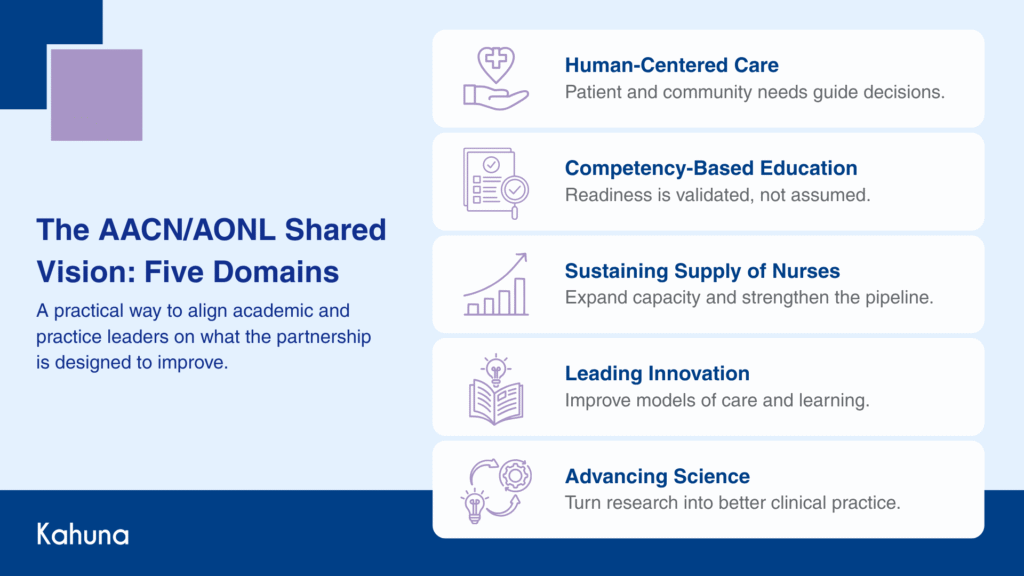
One of the most useful parts of the AACN/AONL playbook is its shared vision framework. The playbook organizes partnership work around five domains: human-centered care, competency-based nursing education, sustaining the supply of highly educated nurses, leading innovation, and advancing nursing science.
1. Human-Centered Care
Human-centered care keeps the partnership grounded in the needs of patients, communities, learners, and the workforce. In the playbook, this concept goes beyond bedside interactions to include designing systems, learning environments, and workflows that reflect the realities nurses face in practice. In an academic-practice partnership, that can look like:
- Clinical experiences that reflect real patient and community needs
- Shared expectations for communication, teamwork, and safe practice
- Stronger links between education, clinical care, and community-based settings
For leaders, this domain is a reminder that readiness is not only about task completion. It is also about preparing nurses to deliver safe, context-aware care in the environments where they will actually work.
2. Competency-Based Nursing Education
Competency-based nursing education focuses on demonstrated ability, not just exposure, hours completed, or time in role. The playbook calls out the need for shared language, observable performance expectations, consistent evaluation methods, and stronger alignment between academic and clinical assessment.
This can have real implications for partnerships. If one preceptor says a learner is ready, another says they are not, and faculty use different standards from practice leaders, readiness becomes subjective. Over time, that inconsistency makes it harder to standardize onboarding, defend readiness decisions, or improve outcomes. A stronger approach includes:
- Shared definitions of competence for core skills and role-based expectations
- Consistent assessment methods across faculty, preceptors, and sites
- Progression tied to validated performance rather than time alone
- Feedback loops that show where learners and new graduates commonly stall
This is also where competency data becomes important. Without a consistent way to validate and view progress, partnerships can talk about readiness without being able to measure it clearly, standardize it across sites, or use it to support transition-to-practice decisions.
3. Sustaining the Supply of Highly Educated Nurses
Partnerships are often discussed in terms of placements, but the larger issue is workforce supply. AACN and AONL position these collaborations as a way to expand nursing school capacity while also strengthening the long-term workforce pipeline. To do that, the partnership has to support quality and scale at the same time, which means planning for:
- Coordinated placement models
- Stronger preceptor development and support
- Alignment between school cohorts and health system demand
- Targeted pathways for specialty areas and hard-to-staff units
When this works well, the Academic-Practice partnerships help to produce graduates as nurses who are better prepared for the settings that need them most.
4. Leading Innovation
Academic-practice partnerships create space to test better ways of preparing and supporting nurses, but innovation only matters if it improves readiness and can be sustained. The playbook includes examples such as simulation-based learning tied to real workflows, shared rubrics, digital portfolios, and closer alignment between academic programs and nurse residency pathways. These approaches help reduce the disconnect between what is taught, what is assessed, and what practice actually demands.
For leaders, this domain is less about novelty and more about useful change. It can include:
- Co-designed transition-to-practice pathways
- Simulation and assessment methods that reflect real clinical complexity
- Shared digital tools for tracking learner progress across settings
- Pilot programs with defined measures before broader rollout
Innovation becomes valuable when it makes readiness more visible, support more targeted, and scaling more realistic. That is also where platforms like Kahuna can be useful, helping academic and practice leaders connect competency expectations, assessment workflows, and progression data more effectively across settings
5. Advancing Nursing Science
The strongest academic-practice partnerships do more than support workforce logistics. They also help close the gap between research, education, and care delivery. AONL’s workforce compendium and the AACN/AONL playbook both point to scholarship, evidence-based practice, and shared learning as important parts of durable partnerships. That includes identifying clinical problems together, measuring outcomes reliably, and using findings to improve both curriculum and care. In practice, this can include:
- Joint research or inquiry priorities
- Stronger use of evidence to guide practice and educational design
- Shared metrics that allow leaders to compare outcomes over time
- Mechanisms for translating lessons learned into curriculum and operational changes
This matters because a partnership that learns from its own data is much more likely to improve than one that relies on anecdotal success stories.
What Makes an Academic-Practice Partnership Succeed?
Many partnerships start with strong intent, but fewer are built to last. AACN and AONL consistently emphasize that effective academic-practice partnerships require structure, formal agreements, shared goals, and outcome tracking. In practical terms, sustainable partnerships usually share a few characteristics, including:
Shared Goals That Can Be Measured
Broad alignment is not enough. The partnership needs a small set of outcomes both sides care about, such as increasing placement capacity without overloading preceptors, improving readiness for specific units or specialities, shortening time to validated readiness in transition-to-practice, or improving retention for new nurses at six and 12 months, with measures both sides can review consistently over time.
Clear Roles and Governance
Partnership work becomes fragile when roles are vague or decision-making is informal. Stronger models usually define executive sponsors, workstream owners, review cadences, and accountability for assessment, feedback, and reporting.
Consistent Evaluation Methods
One of the biggest risks in any academic-practice partnership is variation in how readiness is judged. Shared rubrics, aligned competency language, preceptor development, and structured feedback help reduce that variation. The playbook specifically highlights joint faculty-preceptor planning, shared dashboards, digital portfolios, and preceptor development as practical ways to improve consistency, especially when those tools support more structured validation and clearer records of demonstrated performance.
Outcome Tracking
Partnerships are easier to sustain when leaders can point to results. Useful measures may include placement growth, competency attainment, time-to-readiness milestones, preceptor consistency, retention, and selected quality or safety indicators connected to targeted competencies, rather than relying on fragmented records or anecdotal feedback alone.

With nearly one in four new graduate nurses leaving within the first year and an average bedside RN replacement cost of $61,110, Kahuna helps organizations establish more structured, competency-driven transition-to-practice models that improve readiness, support preceptors, and reduce repeat onboarding.
Learn More: Explore how Kahuna supports workforce readiness across healthcare.
Where Academic-Practice Partnerships Often Stall
Even promising partnerships tend to struggle in familiar ways if definitions are not aligned, preceptor strain is underestimated, or if competency information lives in too many places.
Definitions Are Not Aligned
Terms like practice-ready, competent, and ready for independence can mean different things across schools, units, and leaders. Without shared definitions, evaluation becomes inconsistent, which makes it harder to align academic preparation with practice expectations.
Preceptor Strain is Underestimated
Preceptors are essential to readiness, but many partnerships still treat preceptor support as informal. When expectations, tools, and time are not built into the model, assessment quality becomes harder to sustain, and administrative burden tends to grow along with placement and onboarding demands.
Competency Information Lives in Too Many Places
Readiness data is often scattered across spreadsheets, forms, LMS records, assessments, and manual notes. That makes it difficult to answer basic questions consistently, such as:
- Which competencies are being validated across sites?
- Where do learners or new graduates struggle most?
- Are assessment standards being applied consistently?
- How does competency progress connect to onboarding and retention outcomes?
This is where operational infrastructure matters. A partnership may have the right strategy, but if readiness is still tracked manually, it is much harder to scale the work, prove impact, or use competency information in a way that supports better decisions across the partnership.
How Kahuna Can Support Academic-Practice Partnerships
Kahuna’s role in this conversation is not to replace the partnership model, but to help make the competency side of that model more consistent, visible, and usable. For organizations working to operationalize academic-practice partnerships, that means supporting a shared framework for readiness, more consistent validation across faculty and preceptors, clearer visibility into progression, and records leaders can use to guide onboarding, transition-to-practice, and workforce planning.
A Shared Competency Framework
Partnerships need a common language for readiness across roles, cohorts, specialty units, and clinical settings. A structured framework helps schools and health systems align expectations more clearly, so readiness standards are easier to define and apply across the partnership.
More Consistent Skill Validation
Training completion alone does not validate whether a novice nurse can perform safely and consistently in practice. The application of knowledge is the key. Structured validation helps reduce variation across preceptors, units, and clinical settings, which is especially important when multiple evaluators are contributing to readiness decisions.
Clearer Progression Through Transition to Practice
Leaders need to see how nurses are progressing through transition to practice, where support is needed, and whether milestones reflect demonstrated proficiency rather than time alone. When expectations are clear and progress is visible, new nurses are more likely to feel confident and satisfied in their role, which supports retention. With about 24% of new graduate nurses leaving within the first year and an additional 19% are leaving before they finish their second year of practice, a more transparent transition-to-practice program can help prevent early turnover and reduce avoidable costs. The average cost to replace a bedside RN is $61,110, so even small improvements in progression and support can add up quickly for a single facility.
Better Readiness Visibility and Reporting
When competency records are easier to review over time, leaders have a stronger foundation for workforce planning, onboarding decisions, and partnership reporting. For chief nursing officers, deans, educators, and practice leaders, that kind of visibility can help turn a strong partnership concept into a model that is easier to manage and improve, especially as the partnership grows across cohorts, units, or sites.
In this context, Kahuna’s value is not simply digitizing competency checklists. It helps academic and practice leaders run a more structured transition to practice by aligning academic preparation with clinical reality, reducing transition shock, and making readiness more consistent and measurable across cohorts. When early progression is clear and competency is validated in a consistent way, novice nurses build confidence and a stronger sense of belonging, which can help lower the turnover that often occurs in the first 12 to 24 months of practice.
Hours and Activities Tracking
Validated Readiness Tracking
Formal training is treated as proof of readiness, despite clear performance shortfalls in real-world conditions
Shows which competencies were validated, when, and by whom
Confirms participation, but doesn’t reliably show capability
Confirms proficiency against clear expectations
Often leads to orientation “starting over” to close unknown gaps
Lets orientation focus on remaining gaps and unit-specific needs
Makes it harder to compare readiness across cohorts and sites
Makes readiness easier to measure and standardize across cohorts
Turning Academic-Practice Partnerships into Long-Term Sustainability
If you are building or refreshing an academic-practice partnership, a strong place to start is with the basics. Define the workforce problem the partnership is meant to solve. Agree on what practice readiness means in measurable terms. Identify which outcomes matter most to both sides, standardize how performance will be assessed, and make sure preceptors are supported as part of the model rather than treated as an afterthought.
Just as important, create a reliable way to track progress and report outcomes over time. That is often where promising partnerships either gain traction or lose momentum. Shared vision matters, but sustainable results come from shared standards, consistent assessment, and clear visibility into readiness.
For nursing leaders and academic partners, that is what turns a partnership from a good idea into a working model that can grow. When readiness is defined clearly, validated consistently, and supported with better data, partnerships are in a much stronger position to improve practice readiness, strengthen transition to practice, and support long-term workforce goals, which is where Kahuna can help by making readiness more visible and competency operations easier to sustain over time.

Frequently Asked Questions About Academic-Practice Partnerships in Nursing
An academic-practice partnership in nursing is a formal collaboration between nursing education and nursing practice leaders. Its purpose is to align education and clinical practice in ways that expand capacity, improve readiness for practice, and support a stronger nursing workforce.
They help nursing schools and health systems address shared challenges, including limited clinical capacity, uneven readiness for practice, and the difficulty of transitioning new nurses into real care environments. Stronger alignment makes preparation, support, and workforce planning more consistent.
Useful measures often include placement capacity, competency attainment, preceptor consistency, time-to-readiness milestones, and retention of new nurses. The most effective metrics are shared by both partners and tied to the partnership’s stated goals.
Competency-based education gives academic and practice leaders a clearer way to define readiness around demonstrated performance, not just completed hours or exposure. That helps reduce variation in assessment and improves alignment between education and practice expectations.
Technology can help by centralizing competency frameworks, assessment workflows, progression tracking, and readiness records. That makes it easier for leaders to see progress, identify gaps, and report outcomes across the partnership.